This document provides background information on the statistical release ‘Participation in education, training and employment by 16 to 21 year olds in England’. It explains the concepts and methods used to calculate the participation estimates and provides an overview of the data sources and other relevant information.
Participation in education, training and employment age 16 to 21
- Published
Introduction
Developments made to these statistics
Since the accreditation of these official statistics as National Statistics in March 2012 (opens in new tab), the following developments have been made to improve them for users:
From the 2026 publication
In 2026 data underpinning estimates of participation in education and apprenticeships moved to using a matched administrative dataset (YPMAD) rather than separate administrative sources to capture participation in the state-funded sector. The YPMAD matches data at an individual level in order for DfE to see the complete picture of education and attainment from the following sources:
- School census- data from state-funded schools at pupil level and independent schools at provider level
- Individualised learner record (ILR)- data from FE settings and for apprenticeships
- Higher Education Statistics Agency (HESA)- data from HE providers
- Awarding bodies- for attainment
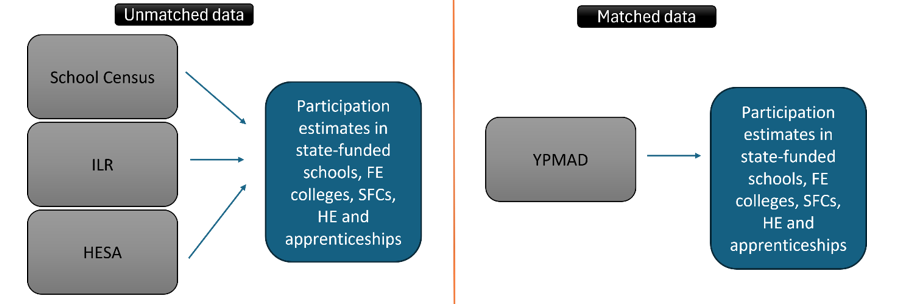
This new approach improved the quality of estimates as some duplication across sources was removed and it also presented us with the opportunity to extend the coverage of the release from age 16-18 to age 16-21.
It also means that pupil characteristics and geographic breakdowns are now possible for those young people educated in the state-sector at age 15 and these have been added to the release.
The methodology for estimating proportions of the England population in wider training, employment (not in education and training) and not in education and employment and training (NEET) from the labour force survey (LFS) has been simplified and is now harmonised with that published in the release NEET age 16 to 24.
The timeseries has been ran using the matched data and the harmonised LFS methodology from 2015-2025 to ensure comparability and a coherent timeseries. This has led to some revisions to previous estimates as detailed in the 'Revisions to previous estimates' section of this document however trends remain consistent.
Coverage and cohorts
Ages
The data in this publication covers young people who reside in England, and is based on their academic age, that is their age at the start of the academic year, 31st August. The publication includes data on individual ages 16 to 21.
Cohorts
England population
Headline data is presented as a proportion of the England population as estimated by the Office for National Statistics (ONS).
DfE administrative data is used to estimate proportions participating in education and apprenticeships. The Labour Force Survey (LFS) is then used to estimate the proportion of the remaining population in wider training (not captured in administrative data), in employment and not in education, employment or training (NEET).
This headline data is only available at national level and cannot be disaggregated to sub-national levels, or by characteristics other than sex due to the methodology used.
Participation estimates for the full population are broken down by:
- academic age
- sex
- provider type
- whether full-time (FT) or part-time (PT)
- highest study aim.
State-sector cohort at age 15
In addition to the headline data, in order to look at participation rates by characteristics and geography this release includes participation rates in education and apprenticeships at ages 16 to 21 for those young people who were educated in the mainstream state-sector in England at age 15.
The state-sector figures are based on young people who were included in the main spring pupil level census in the year in which they turned 16 (academic age 15). As well as pupils in maintained mainstream schools, academies and maintained special schools, this will also include the small number of pupils attending non-maintained special schools as these are covered by the school census.
Estimates of participation in education and apprenticeships at ages 16 to 21 are expressed as proportions of the age 15 cohort and are presented by:
- (academic) age
- sex
- provider type
- highest study aim
- ethnicity
- special educational needs and disability (SEND)
- disadvantaged status
- free school meals (FSM) eligibility
- deprivation indices (Income Deprivation Affecting Children Index (IDACI) quartile )
- prior attainment at level 2 and at level 2 in English and maths
- local authority of school location at age 15
Overseas students
This publication excludes learners studying overseas. Overseas students studying in English FE and English HE are included in the national figures. Learners from Wales, Scotland and Northern Ireland attending England providers are included in the national figures.
Data sources
| Data source | |
|---|---|
| School census | The school census is a statutory pupil level data collection for all maintained schools, including local authority maintained special and non-maintained special schools, academies including free schools (secondary free schools, studio schools and university technical colleges) and city technology colleges in England. The school census is collected on a termly basis with 3 collections per calendar year. This publication uses post 16 learning aims from the autumn school census collected in October. Independent schools submit school-level data via the annual school level census (SLASC). These estimates are added to the matched administrative data for ages 16 to 18 to give a comprehensive picture of participation in schools in England. |
| ILR- Further Education (FE) Institutions | The Education and Skills Funding Agency (ESFA) Individualised Learner Record (ILR) provides data on learners in FE sector colleges. The ‘FE college’ sector is mainly general FE, tertiary and specialist college provision, but also includes some publicly funded provision delivered through commercial, charitable and local authority providers. Snapshot data as at 1 November is used. The data used for provisional estimates is the annual SN06 freeze and for final estimates the SN14 freeze. The ILR data for the latest year is provisional and is scheduled to be revised in the following year’s publication (usually in June). |
| ILR-Apprenticeships | The ESFA ILR provides monthly data on young people on apprenticeships. Snapshot data as at 1 January has been used. |
| Higher Education Institutions (HEI) | Students in institutions of higher education in England on 1 December are included from data supplied by the Higher Education Statistics Agency (HESA). Further information on the collection can be found at: HESA - Experts in higher education data and analysis. To be included in the estimates students must not be studying abroad, on a sabbatical nor a dormant student. Distance learners such as those at the Open University are included. |
| Labour Force Survey (LFS) | Figures on wider training, employment (not in education or training) and those not in education, employment or training (NEET) come from the Q4 (October to December) LFS data for each year. The LFS is a quarterly survey of approximately 50,000 households in England however sample sizes have been falling in recent years. If an individual is not available for interview, another member of the household may respond on their behalf. ONS employment and labour market statistics See also weaknesses of the data section. |
| Population estimates | The population estimates for academic year ages in January of each year are derived by DfE from mid-year estimates and projections provided by the Office for National Statistics (ONS). Population estimates are subject to statistical uncertainties arising from sampling error and imputation effects when using census data, as well as from estimation of the components that age the population forward from the census date. It is routine for population estimates and projections to be revised following a new census. Concerns have been raised regarding the population projections and mid-year population estimates for England and Wales resulting in a review being carried out by the Office for statistics regulation (OSR) to assess the extent to which the mid-year estimates continue to meet the standards of Trustworthiness, Quality and Value of the Code of Practice for Statistics. This may lead to future revisions and caveats around estimates. |
Methodology
The estimates in this release of participation in education, training and employment combine data from the following sources:
- ONS population estimates
- School Census
- Individualised Learner Record (ILR)
- Higher Education Statistics Agency (HESA)
- Labour Force Survey (LFS)
Population
The population in England at each age is based on Office for National Statistics (ONS) estimates, adjusted so that they relate to academic age and the end of the calendar year.
Education and apprenticeships
Participation data from the Young Persons Matched Administrative Data (YPMAD) which includes the following collections:
- pupil level school census (PLASC)- The census collects a wide range of data, including personal details and special educational needs, to create a comprehensive record of each student's educational journey.
- Individualised learner record (ILR)- The Individualised Learner Record (ILR) is a mandatory data collection system used by further education and skills providers in England to report learner information to the Department for Education (DfE).
- higher education statistics agency (HESA)- HESA collects data on various aspects of higher education, including student demographics, academic performance, and funding allocations.
In addition, participation in independent schools is estimated using the ‘school level annual school census’ (SLASC), an annual, statutory census that takes place every January. It collects data about registered independent schools, including pupil numbers, characteristics, and other relevant information.
Wider training
The total proportion of the England population aged 16 to 21 in education and training is estimated from the labour force survey (LFS) and is as published in the DfE release NEET age 16 to 24.
The proportion of the England population in education and apprenticeships is estimated using administrative data from the YPMAD and independent school sector as outlined above.
Wider training is then computed as:
Wider training = LFS estimate of % in all education and training - administrative estimate of % in education and apprenticeships
Not in education and training (NET)
The total proportion of the England population aged 16 to 21 not in education or training (NET) is estimated from the labour force survey (LFS) and is as published in the DfE release NEET age 16 to 24.
No adjustments have been made to these estimates.
Employment (of those NET)
The total proportion of the England population aged 16 to 21 not in education and training (NET) but in employment is estimated from the labour force survey (LFS) and is as published in the DfE release NEET age 16 to 24.
No adjustments have been made to these estimates.
NEET (not in education, employment or training)
The total proportion of the England population aged 16 to 21 not in education, employment or training (NEET) is estimated from the labour force survey (LFS) and is as published in the DfE release NEET age 16 to 24.
No adjustments have been made to these estimates.
Reference dates
The estimates relate to a snapshot of activities at the end of the calendar year. The reference dates of the various post-16 sources are taken as close to the end of the calendar year as possible:
| Source | Reference date |
|---|---|
| Population | January |
| Schools | October |
| Independent schools | January |
| Further Education Institutions | November |
| Apprenticeships | January |
| Higher Education Institution | December |
| Labour Force Survey | Q4 (Oct-Dec) |
Definitions
| Definition | |
|---|---|
| Academic Age | Age of a learner at the beginning of the academic year, 31 August. |
| Geography | For all geographic data, assignment is based on the school attended in the academic year the young person turned 16. As with the School performance tables, the local authority (LA) of the school is based on the administrative LA rather than its postcode (this only differs in a very small number of cases). Boundaries are assigned as at the start of the year the young person was 15 (turned 16) and are based on office for national statistics (ONS) lookups which can be found on the Open Geography Portal. |
| Full time education (FTE) | The full-time education definition varies according to institution type. In schools, full-time learners study 10 sessions a week (1 session is half a day). In further education institutions: a) From 2013 a full-time learner is defined as someone enrolled on a programme of learning totalling 540+ planned hours per year, from either qualification guided learning hours (GLH) or employability, enrichment and pastoral (EEP) planned hours; b) Prior to 2013 full-time learners are defined as those enrolled on programme of learning of 450+ qualification guided learning hours per year, or at least 150 GLH per tri-annual period, or more than 16 GLH per week for shorter courses. In Higher Education Institutions, full-time learners study 21 hours a week for 24 weeks a year. All participation in special schools is classified as full-time in this release. |
| Part time education (PTE) | Where the mode of education is not classified as full-time, as in the above methodology, then it is assumed that the mode of study is part-time. In some ILR records the number of qualification guided learning hours (GLH) and employability, enrichment and pastoral (EEP) planned hours are recorded as NULL. These records are classified as part-time in the tables. Many of those ILR records with NULL hours are private Ltd companies where study is likely to be part-time. |
| Apprenticeships | An apprenticeship is a real job with training that allows individuals to earn a wage while gaining job-specific skills and a nationally recognised qualification. Apprenticeships in this release are as recorded in the Individualised Learner Record (ILR) for tracking and funding by the Education and Skills Funding Agency (ESFA). Where a young person is participating in both an education course and an apprenticeship the apprenticeship will be shown as the highest qualification aim. The apprenticeship framework is broken down into specific levels: Intermediate (Level 2),
Advanced (Level 3)
Higher (Levels 4 and 5)
Degree (Levels 6 and 7)
|
| Labour Force Survey (LFS) | The LFS covers all residential households and nursing accommodation. Householders are asked to reply on behalf of students living away in halls of residence. The LFS excludes people outside such accommodation - chiefly hospital residents, people in prison, people in army barracks and the homeless. The LFS is a sample survey so all estimates of labour market participation are subject to sampling error. |
| Wider training | Refers to young people who are studying, but are not thought to be captured in DfE administrative data. Participation in wider training in this release is estimated using the labour force survey (LFS) where the total in education and training estimate is taken from the published statistics series NEET age 16 to 24 and the estimate of the England population in education and apprenticeships from DfE administrative data is simply subtracted to estimate this additional ‘wider training’. It includes some employer funded training (EFT). Figures for EFT cover employees who have responded to the labour force survey as received training in the past 4 weeks; these figures are restricted to training other than apprenticeships, they cover only young people who are in employment. Wholly privately funded training not picked up in the administrative data collections is also included under wider training again this is estimated using the labour force survey. |
| Employment (not in education or training) | The estimate of the proportion of the population in employment (not in education or training) in this release is estimated using the labour force survey (LFS). The estimate is taken from the published statistics series NEET age 16 to 24. |
| Not in education, employment or training (NEET) | Anybody who is not in any of the forms of education or training and who is not in employment is considered to be NEET. As a result, a person identified as NEET will always be either unemployed or economically inactive. NEET is estimated in the publication using the LFS and is as published in the release NEET age 16 to 24. |
| Qualification levels | If a young person is studying qualifications at different levels they are reported against their highest level of study. Apprenticeships are reported as the primary qualification aim if there is an overlap with another qualification including those on degree apprenticeships. All qualifications studied are then classified as one of the following seven main categories:
Qualification levels are defined by the Qualification and Credit Framework (QCF). For further information and examples see Compare different qualifications. Young people in full-time education studying more than one course are attributed to the course appearing first in the list. Traineeships - Due to relatively small numbers, traineeship numbers are included in the overall level 1 or 2 estimates. |
| Provisional data | The figures for the latest year are provisional and will be updated in the next annual release. All other figures are final but are subject to change if revised population estimates become available. |
Pupil characteristics
Special Educational Needs (SEND)
Pupils with Special educational needs (SEN) have learning difficulties or disabilities that can make it harder for them to learn than most pupils of the same age.
Pupils with special educational needs comprise of those receiving SEN support (prior to 2015 School Action or School Action Plus) or those with an Education, health and care plan (EHCP) (prior to 2015 a statement of SEN).
In this release the relevant tables use the new and the older terminology combined:
- SEN without statements or EHC plans – This category includes those on SEN support. Extra or different help is given from that provided as part of the school’s usual curriculum. The class teacher and special educational needs co-ordinator (SENCO) may receive advice or support from outside specialists. The pupil does not have a statement or education, health and care plan (EHCP). Those previously classified as school action (where extra or different help is given, from that provided as part of the school’s usual curriculum) or school action plus (where the class teacher and the SENCO receive advice or support from outside specialists) are reported in this category.
- SEN with statements or EHC plans – a pupil has a EHC plan, previously a statement of SEN, when a formal assessment has been made. A document is in place setting out the child’s needs and the extra help they should receive.
State sector data shows the primary type of SEN at academic age 15. Primary type of need is collected for those pupils on SEN support or with a EHC plan. Pupils who had a statement of SEN or were school action + under the old classifications had their primary need recorded. Pupils who were previously school action were not required to have a primary type of need recorded.
The four broad areas of special educational needs are:
1. Cognition and Learning
This covers children who learn at a slower pace or have difficulty accessing the standard curriculum.
- Moderate Learning Difficulties (MLD): Broad challenges with basic literacy, numeracy, and understanding concepts.
- Severe Learning Difficulties (SLD): Children who need support in all curriculum areas and may have associated mobility or communication issues.
- Profound and Multiple Learning Difficulties (PMLD): Severe and complex learning difficulties alongside physical disabilities or sensory impairments.
- Specific Learning Difficulties (SpLD): Conditions that affect specific aspects of learning, such as dyslexia, dyspraxia, and dyscalculia.
2. Communication and Interaction
This category includes difficulties with speaking, understanding, and making sense of language.
- Speech, Language and Communication Needs (SLCN): Challenges in communicating effectively with others or processing language.
- Autism Spectrum Disorder (ASD): Conditions that affect how a child interacts socially, communicates, and perceives the world.
3. Social, Emotional and Mental Health (SEMH)
This is an umbrella term for difficulties that hinder a child's well-being, relationships, and ability to engage in learning.
- Mental Health Needs: Includes conditions like anxiety, depression, or medically unexplained physical symptoms.
- Behavioural Difficulties: May include withdrawal, isolation, or challenging behaviour, as well as conditions like Attention Deficit Hyperactivity Disorder (ADHD).
4. Sensory and/or Physical Needs
This covers medical or physical conditions that require specialized equipment or ongoing additional support to access the school environment.
- Visual Impairment (VI) or Hearing Impairment (HI): Partial or severe loss of sight or hearing.
- Multi-Sensory Impairment (MSI): Combined visual and hearing impairments.
- Physical Disability (PD): Conditions that hinder a child's physical ability to access the standard educational provision.
Free School Meals
Free school meal eligibility is used as a proxy for deprivation, and relates to those who meet the eligibility criteria and make a claim.
Prior to 2001, the numbers eligible for a free school meal were those pupils who had, or whose parents had, satisfied the relevant authority that they were receiving Income Support (IS) or income based Jobseekers Allowance (IBJSA) or support provided under Part 6 of the Immigration and Asylum Act 1999. From 2001 onwards this definition was modified to include only pupils where parents had indicated that they wished their child to have a free meal and had confirmed benefit receipt with the LA or school.
Under changes to the tax credit system introduced in April 2003, children in families receiving the Child Tax Credit (CTC) rather than IS or IBJSA would not have been entitled to receive a free school meal. As a result, for 2004 School Census, the entitlement for free school meals was extended to 'non-working' families who have an amount of income that extinguishes their IS or IBJSA benefit, who are receiving support via CTC, but are working fewer than 16 hours per week and thus not in receipt of Working Tax Credit (WTC). The majority of these families would have received IS or IBJSA prior to 6 April (and accordingly their children a free school meal). As a result of this change to entitlement, these children continue to be eligible for free school meals.
Disadvantaged
Disadvantaged pupils are recorded as falling into at least one of the following categories by (academic) age 15;
- being eligible for free school meals on Census day in any termly or annual Census in the last 6 years up to the learners current year, or the learner must have been recorded as eligible for FSM in any other termly School Census. This includes the Alternative Provision (AP) and the Pupil Referral Unit (PRU) Census.
- being part of a Post looked After Arrangement (PLAA) through adoption, a guardianship order or a child arrangement.
- being looked after for at least one day during the year.
Income Deprivation Affecting Children Index (IDACI)
IDACI was developed by the Department for Communities and Local Government (CLG), now the Ministry of Housing, Communities & Local Government (MHCLG). The index is based on Super Output Areas (SOAs) in England. IDACI is a subset of the Income Deprivation Domain of the Index of Multiple Deprivation.
Each SOA is given a score showing the percentage of pupils aged under 16 that live in families that are income deprived, i.e. they are in receipt of certain benefits and their equivalised income is below 60 per cent of the median before housing costs.
Each SOA is then given a rank between 1 and 32,482 where 1 is the most deprived SOA. This release reports on attainment for the 25% ranked most deprived compared with the 25% ranked least deprived.
The English indices of deprivation 2025 (opens in new tab) were published on 30 October 2025. They update the English indices of deprivation 2019. This attainment release uses the latest data available at the time of publication.
Ethnicity
Ethnicity is broken down into two main variables: a minor grouping variable and a major grouping variable.
If a pupil or parent has refused to give the information then refused is recorded and returned. Ethnicity is a personal awareness of a common cultural identity. Ethnicity relates to how a person feels and not necessarily how they are perceived by others. It is a subjective decision as to which category a person places themselves in and therefore does not infer any other characteristics such as religion, country of origin etc. Ethnicity monitoring advice is available from the Department’s website.
The DfE main ethnicity categories and descriptions:
| Ethnic grouping | code | code description |
|---|---|---|
| White | WBRI | White – British |
| White | WIRI | White – Irish |
| White | WIRT | Traveller of Irish Heritage |
| White | WOTH | Any other White Background |
| White | WROM | Gypsy / Roma |
| Mixed | MWBC | White and Black Caribbean |
| Mixed | MWBA | White and Black African |
| Mixed | MWAS | White and Asian |
| Mixed | MOTH | Any Other Mixed Background |
| Asian | IND | Indian |
| Asian | APKN | Pakistani |
| Asian | ABAN | Bangladeshi |
| Asian | AOTH | Any Other Asian Background |
| Black | BCRB | Black Caribbean |
| Black | BAFT | Black African |
| Black | BOTH | Any Other Black Background |
| Chinese | CHNE | Chinese |
| Other | OOTH | Any Other Ethnic Group |
| Refused | REFU | Refused |
| Information not obtained | NOBT | Information not obtained |
Prior attainment
Level 2 by age 15 - A full level 2 in England is broadly equivalent to 5 GCSE grades 4–9 (or A*–C) or an equivalent technical/vocational qualification. It is widely considered the minimum requirement by employers and is a stepping stone to further education or apprenticeships. A young person needs to have achieved this level by academic age 15 (End of year 11) in this measure.
Level 2 in English and maths by age 15- In this measure a young person has achieved GCSE grade 4–9 (or A*–C) or an equivalent qualification (i.e. level 2 functional skills) in both English language and maths by academic age 15 (end of year 11).
Revisions to previously published estimates
Administrative estimates of numbers in education and apprenticeships
As explained in the ‘Developments made to these statistics’ section, in 2026 data underpinning estimates of participation in education and apprenticeships moved to using a matched administrative dataset (YPMAD) rather than separate administrative sources to capture participation in the state-funded sector.
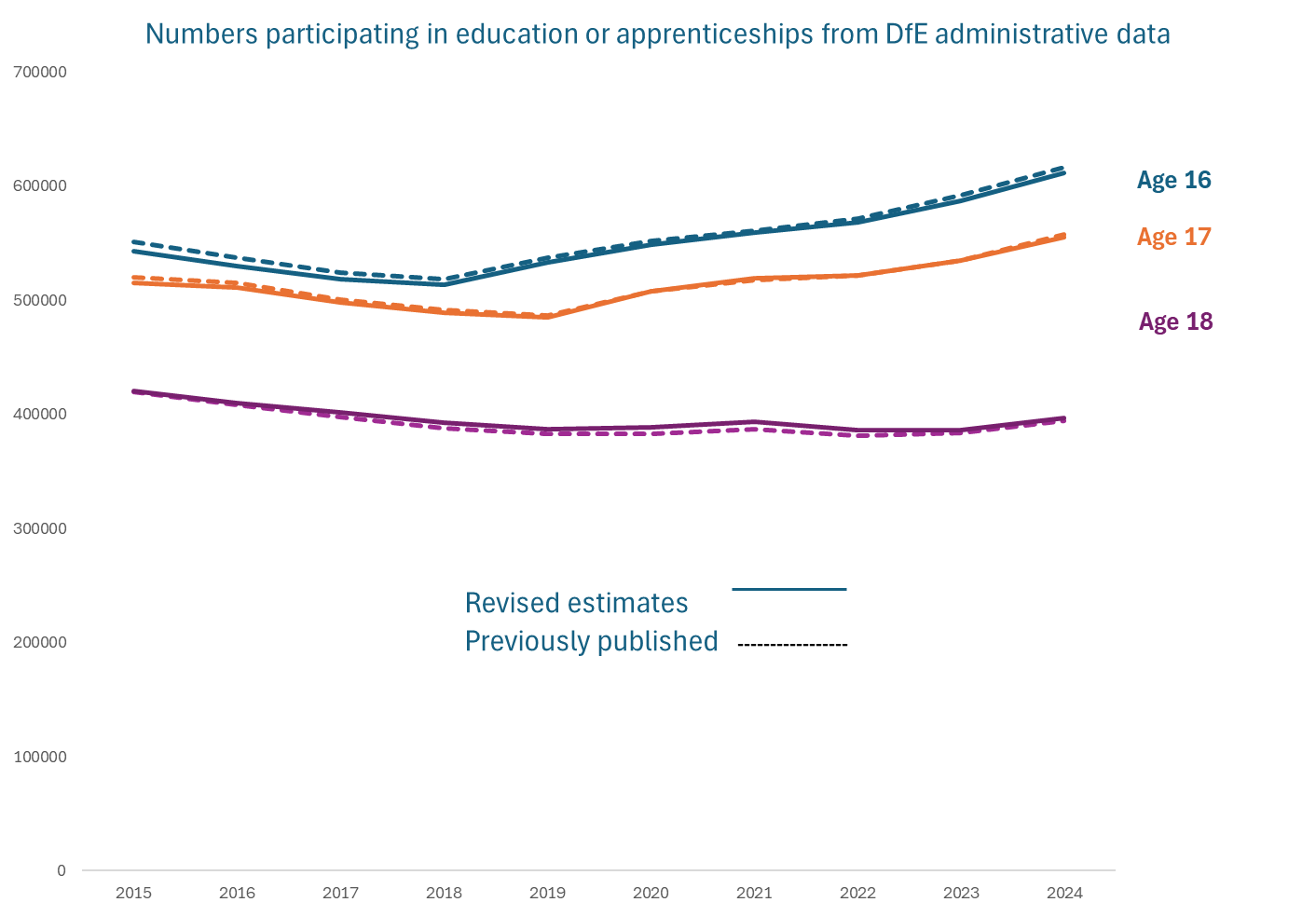
The chart below shows the comparability in estimates for ages 16 to 18 between the previous series as published in the June 2025 release Participation in education, training and employment age 16 to 18 and new estimates from the matched data (YPMAD).
Slight falls at ages 16 and 17 are predominantly due to the deduplication of some qualification aims. Slight increases at age 18 are mainly due to the inclusion of some Welsh participants from the HESA collection who were not previously counted, as their permanent home address prior to university was in Wales. However, as they should be recorded in the ONS population as residing in England if living at university, the methodology has been revised to include them.
Estimates of wider training
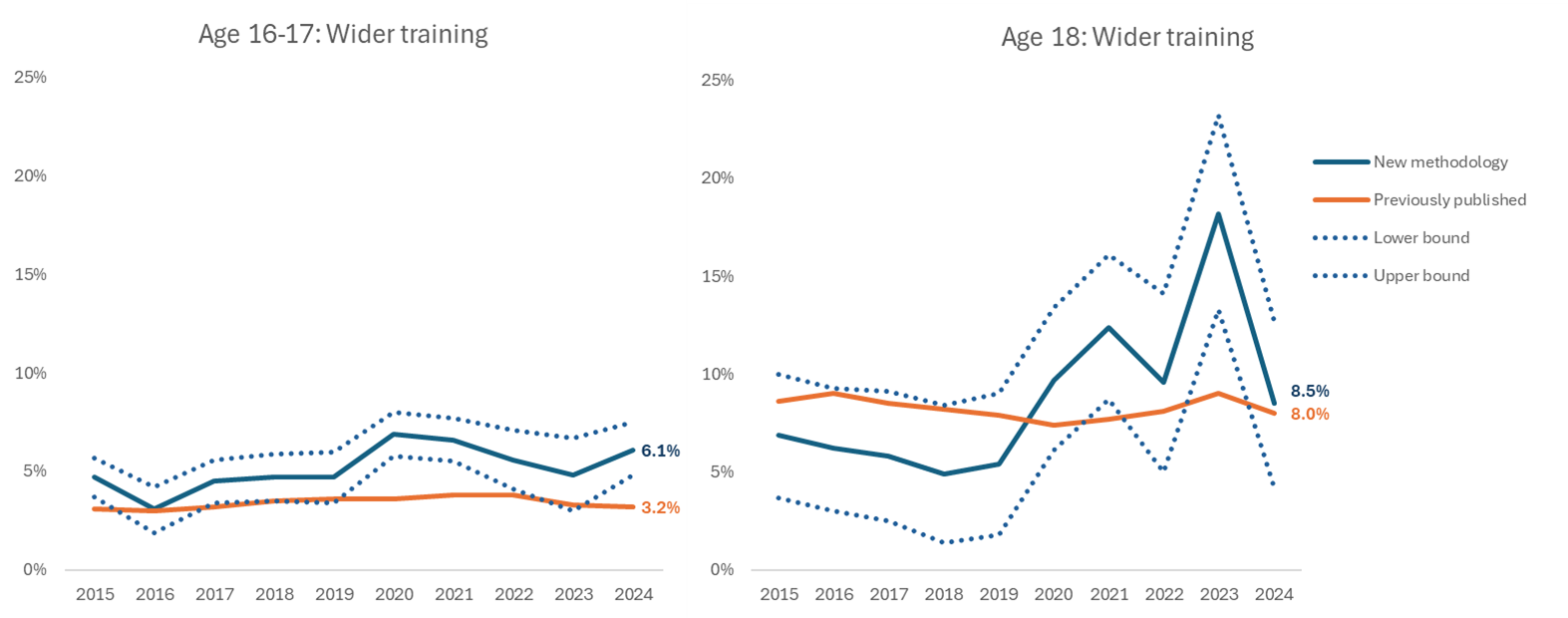
In the new methodology in this release the estimated proportion in any education or training from the Labour Force Survey (LFS) is taken and then proportion in education or on an apprenticeship estimated from administrative data subtracted in order to estimate the proportion in ‘wider training’.
This differs to the old methodology where responses were analysed in the survey to attempt to categorise into education, apprenticeships and wider training and a five year weighted average was used . Due to small sample sizes and difficulties in categorisation, coupled with the five year average diluting latest trends, this simplified methodology is considered more robust and transparent.
Estimates of proportions not in education and training (NET)
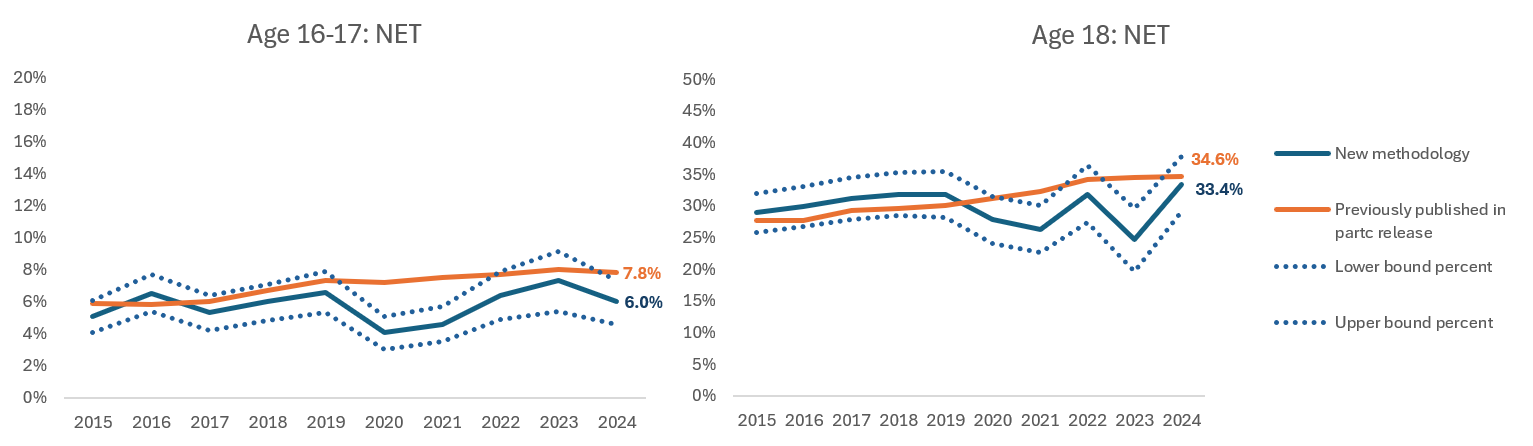
In the new methodology in this release the estimated proportion not in education and training (NET) is taken directly from the Labour Force Survey (LFS).
This differs from the old methodology where the proportion who were NET was derived by subtracting from the population the administrative estimate of education and apprenticeships and the estimate of wider training as above.
This simplified methodology is considered more robust and transparent.
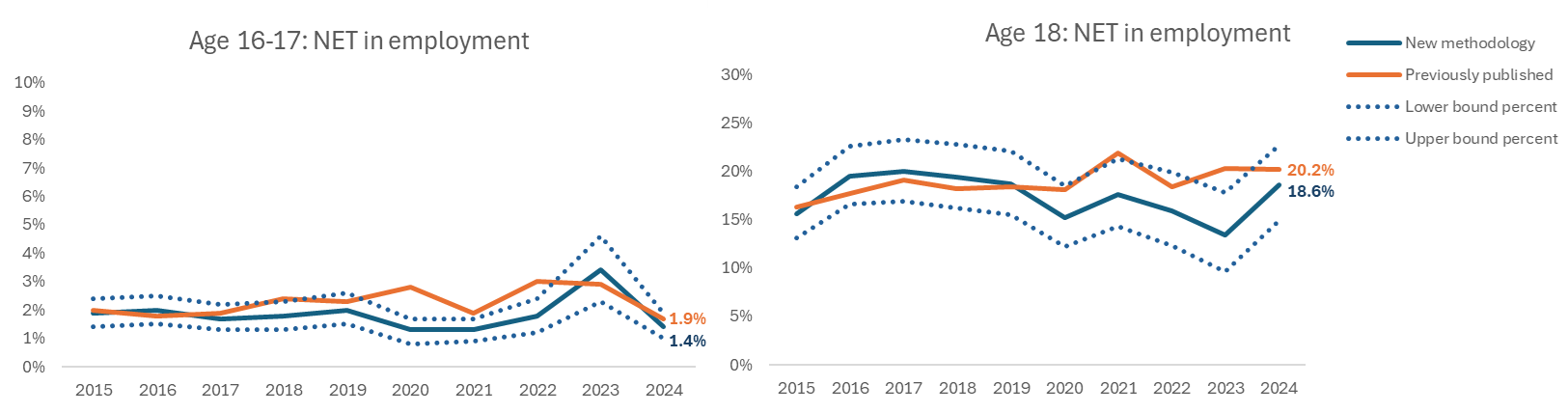
Estimates of proportions not in education and training but in employment
Under the new methodology in this release, the estimated proportion in employment (not in education and training) is taken directly from the Labour Force Survey (LFS).
This differs from the old methodology where the proportion in employment was taken from the LFS and applied to the NET rate as estimated from administrative data for education and apprenticeships and the wider training estimate as above.
This simplified methodology is considered more robust and transparent.
Estimates of NEET
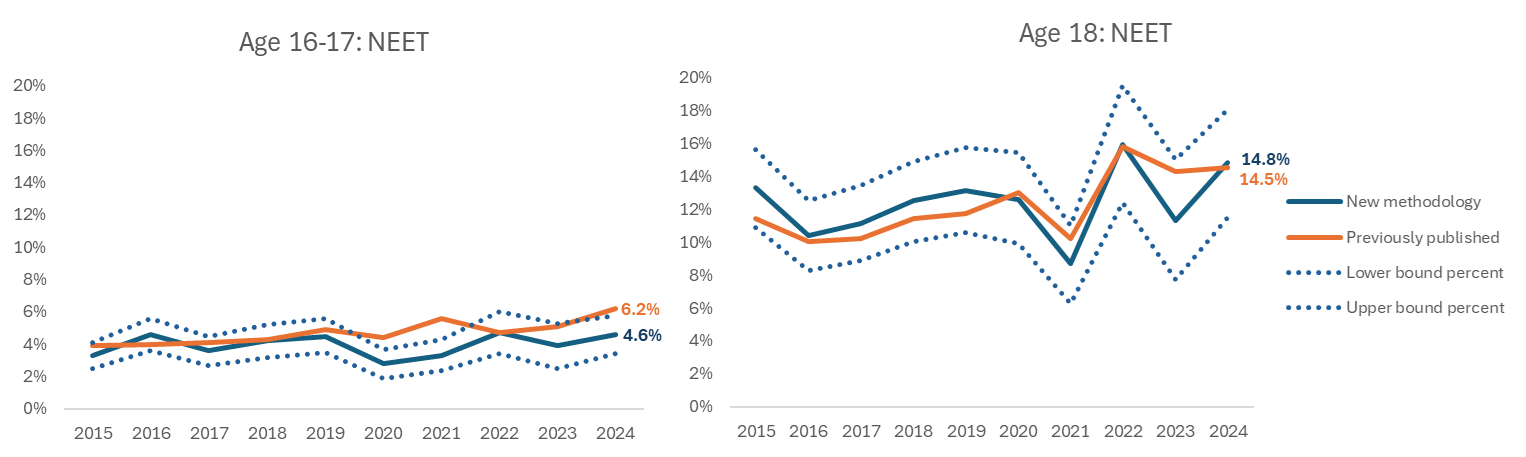
Under the new methodology in this release, the estimated proportion not in education, employment or training (NEET) is taken directly from the Labour Force Survey (LFS).
The previous methodology for deriving NEET used the employment and wider training estimates, as described above, alongside administrative estimates for education and apprenticeships.
This simplified methodology is considered more robust and transparent.
Population
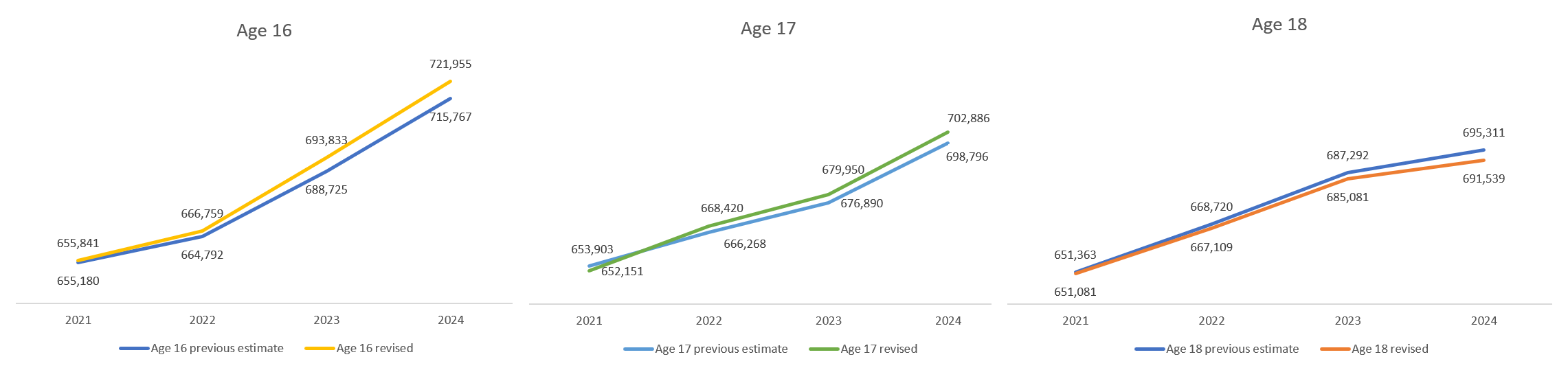
The population estimates for academic year ages in January of each year are derived by DfE from mid-year estimates and projections provided by the Office for National Statistics (ONS).
Population estimates are subject to statistical uncertainties arising from sampling error and imputation effects when using census data, as well as from estimation of the components that age the population forward from the census date. It is routine for population estimates and projections to be revised following a new census.
The charts below show the differences between previous and latest estimates for academic ages 16 to 18 as used in the release Participation in education, training and employment age 16 to 18 and in this latest release following revisions by ONS to mid-year estimates and projections. Estimates in the June 2026 release use mid-year 2024 population estimates for the UK 2024 (released on 30th July 2025) and 2024-based National population projections (released on 28th April 2026).
Concerns have been raised regarding the population projections and mid-year population estimates for England and Wales resulting in a review being carried out by the Office for statistics regulation (OSR) (opens in new tab) to assesses the extent to which the mid-year estimates continue to meet the standards of Trustworthiness, Quality and Value of the Code of Practice for Statistics (opens in new tab). This may lead to future revisions and caveats around estimates.
Uses of data
The main use of these statistics is to provide ministers, government departments and the wider public with a comprehensive picture of recent trends in participation and NEET among those aged 16 to 21.
Weaknesses of the data
Timeliness
Age 16 to 17: the provisional annual figures for age 16 to 17 are usually published in June, 6 months after the period to which they relate.
Ages 18 to 21: most participation takes place in Higher Education Institutions and data is supplied by the Higher Education Statistics Agency (HESA). Currently there is a lag in receipt of the data of 12 months, so in this release the headline data relates to 18 months after the period to which the 18 to 21 data relates. Data is available for 18 to 21 numbers in schools and Further education providers and these estimates are included in the education and apprenticeship breakdowns in the underlying data.
Population estimates
The data uses ONS population figures which are subject to error, which can increase as they move further away from the date of the census, particularly when looking at single age groups. Population data is also subject to revisions which will be reflected in this release.
Impacts of population revisions on this publication series Participation in education, training and employment age 16 to 18 can be found in its accompanying methodology. (This release now covers ages 16 to 21 and has some methodological changes so is published in a new series on explore education statistics platform).
Labour Force Survey
Employment rates of those not in education and training and participation in wider training not captured through DfE administrative data sources are estimated using the Labour Force Survey (LFS).
LFS response rates have seen a decreasing trend in recent decades with a notably smaller sample in 2023 of just 2,400 16-24 year olds. As a result, additional caution should be taken when interpreting estimates. Further information on the LFS and how we use this data to estimate wider participation and NEET rates can be found in this methodology with additional information on sample sizes here: NEET age 16 to 24: methodology
LFS data has been reweighted from January 2019 onwards which has led to a discontinuity in the timeseries.
Raising Participation Age (RPA) compliance measure
Currently this publication has no measure which accurately captures the numbers of young people who comply with the requirements of raising participation age (RPA) although trends can be estimated from the in education and apprenticeship figures. This is because compliance involves participating in full-time education (school/college), apprenticeships, or working/volunteering (20+ hours/week) combined with part-time training. This last element is not measurable using the data sources in this release.
Confidentiality
The Code of Practice for Official Statistics requires we take reasonable steps to ensure that our published or disseminated statistics protect confidentiality.
Suppression has been applied to very small cohorts of less than 5 young people. A ‘c’ in the data represents where these small numbers have been removed. This is consistent with the Departmental statistical policy (opens in new tab).
Differences in proportions quoted in text are calculated from unrounded data and therefore may not always be the same as differences calculated from rounded tables.
Related policy
| Policy summary | Detail |
|---|---|
| 'Raising Participation Age (RPA)', legislation was introduced in 2013/14 requiring 16 and 17 year olds in England to remain in education or training. | Introduced in two stages it applied to: • Young people who left year 11 in summer 2013, who were required to stay in some form of education or training for at least a further year until 27 June 2014; • Young people who started in year 11 (or years below) in September 2013, who were required to continue until at least their 18th birthday. The first cohort impacted by stage 1 of Raising the Participation Age (RPA) legislation were academic age 16 (usually year 12) in 2013/14 (end 2013 figures in this statistics publication) and academic age 17 in 2014/15 (end 2014 figures). Those young people impacted by stage 2 of RPA were academic age 16 in 2014/15 (end 2014 figures) and age 17 in 2015/16 (end 2015 figures). Although participation estimates in this release do not include a measure strictly aligning to compliance with RPA (see next section for differences), the proportion reported as being in ‘education and apprenticeships’ is the closest proxy. Education and apprenticeships (which includes all full and part-time education and apprenticeships but not re-engagement activities) is the headline participation measure in this release. Wider training, funded privately or by employers, which is not picked up in the administrative data collections is included in the ‘Total education and training’ measure. More detail on the differences are given in the policy section of the accompanying technical document. Estimates of participation consistent with the duty to participate under RPA, based on data collected by local authorities, are published at the following link (in Table 2) Participation in Education and Training by Local Authority. It should be noted that as the local authority estimates are based on different data and methodology to those in this statistics publication, they are not directly comparable. |
| There are differences between activity that complies with the duty to participate under RPA and what is captured in this publication | Activity that satisfies the duty to participate under RPA legislation is described in detail in the statutory guidance to Local Authorities. In summary, young people in full-time education or apprenticeships automatically meet the duty to participate, but in order to comply with RPA, part-time education for academic age 16 year olds: (i) must include planned qualification guided learning hours of a minimum 280 hrs per year; (ii) should usually be combined with full-time employment or voluntary work (either 20 hrs per week or 40 hrs over 2 weeks for those with less regular hours). In this publication, participation that is not full-time is automatically counted as part-time, irrespective of planned hours or whether it is combined with employment. This will mean that RPA-compliance will be significantly lower than the proportion of 16 year olds reported as being in education and work-based learning. However, this will be partially offset as 16 year olds engaged in LA approved re-engagement activities will satisfy the duty to participate but the activity might not be recorded in this publication. |
| 16 to 19 funding: maths and English condition of funding | From August 2014 students who have not achieved a good pass in English and/or maths GCSE by age 16 must continue to work towards achieving these qualifications or an approved interim qualification as a ‘stepping stone’ towards GCSE as a condition of student places being funded. Full time students who started their programme on or after 1 August 2015 who have prior attainment of a grade 3 or grade D in GCSE or equivalent in maths and/or English must study a GCSE to meet the condition of funding. For further information see 16 to 19 funding: maths and English condition of funding on GOV.UK. |
| Technical education reform and the post 16 skills plan | Published in July 2016, the post-16 skills plan set out the previous Conservative Government’s plan to support young people and adults to secure skilled employment and meet the needs of the economy. Based on recommendations by Lord Sainsbury’s independent panel, the ambition is that every young person, after an excellent grounding in the core academic subjects and a broad and balanced curriculum to age 16, is presented with two choices:
The academic option is already well regarded, but the technical option must also be world-class, improving both the quality of education and student choice. A framework of 15 routes across all technical education was introduced, grouping together occupations to reflect where there are shared training requirements. Rather than the previous crowded landscape of overlapping qualifications, only high-quality technical qualifications which match employer-set standards are approved. From September 2015, each occupation cluster had approved:
|
| Launch of T Levels | T Levels are new 2-year courses which are taken after GCSEs and are broadly equivalent in size to 3 A Levels. Launched in September 2020, these courses have been developed in collaboration with employers and education providers so that the content meets the needs of industry and prepares students for entry into skilled employment, an apprenticeship or related technical study through further or higher education. T Levels offer students practical and knowledge-based learning at a school or college and on-the-job experience through an industry placement of at least 315 hours – approximately 45 days. The courses are available at selected colleges, schools and other providers across England. Further information can be found on Introduction of T Levels - GOV.UK (www.gov.uk) |
Other sources
NEET and NET age 16 to 24
Annual estimates from the Labour Force Survey of young people aged 16 to 24 not in education, employment or training (NEET) in England are published by DfE usually at the start of March following the release of quarter 4 estimates. Release home - NEET age 16 to 24 - Explore education statistics - GOV.UK
This release uses these estimates for:
- Not in education and training (NET)
- NET in employment
- Not in education, employment or training (NEET)
The ONS also publish estimates for the UK from the labour Force Survey (LFS) and this series can be found here: Young people not in education, employment or training (NEET), UK - Office for National Statistics (opens in new tab).
Key differences between the ONS UK NEET estimates and those for England are:
- The ONS seasonally adjust the UK estimates so that all quarters can be compared. The DfE estimates for England are not seasonally adjusted and the focus is on quarter 4 (Oct- Dec), the start of the academic year.
- DfE NEET estimates are based on academic age (Age as at the 31st August). ONS UK release is calendar age at the time surveyed.
Higher education
Official statistics for Higher Education participation data are published in the release:
The Cohort-based Higher Education Participation (CHEP) measure published here:
This statistic measures higher education (HE) participation by school cohorts. It includes people participating in both traditional HE qualifications at UK higher education providers and English further education providers, as well as work-based learning such as apprenticeships.
Cohorts of 15-year-olds from English state and special schools are monitored through time to create a percentage of those who have participated in HE.
The time series in the CHEP publication focuses on participation in HE by age 25. Participation data for other ages and breakdowns have been made available in the downloadable files
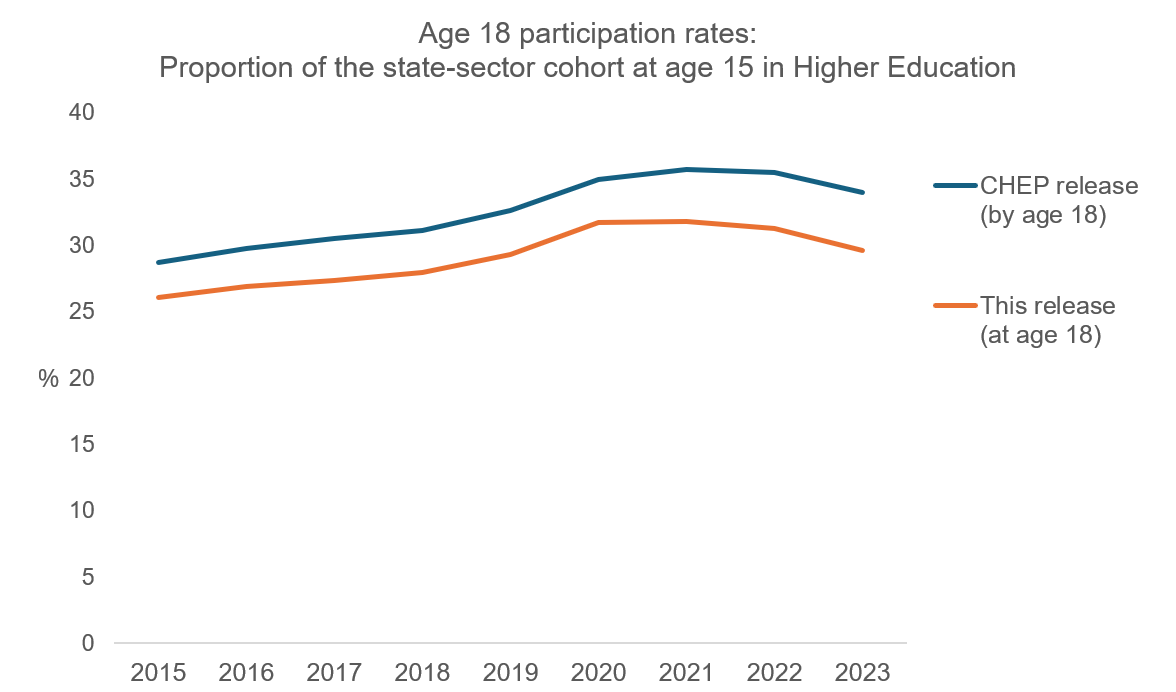
Trends are comparable between estimates in the CHEP release and this 16-21 participation release but there are a number of methodological differences leading to lower estimates, the main ones being:
- Young people participating in both HE qualifications at higher education (HE) providers and further education (FE) providers, as well as apprenticeships are included in the CHEP release figures. In this release those in FE are classified as in General FE and those on an apprenticeship as that in the provider type and qualification aim hierarchy.
- In the CHEP release participation is cumulative, by a certain age whereas in this release it is a snapshot at the end of the calendar year.
An example of the scale of the differences can be seen at/by age 18 below:
Participation in education, training and NEET age 16 to 17 by local authority
The release presents data for England showing the proportion of 16 and 17 year-olds participating in education and training and an estimate of those Not in Education, Employment or Training (NEET) by local authority (LA).
Participation in education, training and NEET age 16 to 17 by local authority
Data is collected using the National Client Caseload Information System (NCCIS) (opens in new tab), which draws together local databases used to support young people to engage in education and training and plan services that meet young people’s needs.
Caution should be taken when using these figures due to the estimates being based on management information data. There is considerable variation at local authority level in how well 16 and 17 year olds are tracked, and hence ‘activity not known’ proportions can impact on the estimates of the proportion NEET.
The release includes an interactive scorecard (dashboard) to enable local authorities (LAs) to compare their performance with other LAs. The scorecard aims to put the headline measures into context by presenting it alongside other measures related to attainment and attendance.
Key differences to the age 16-17 estimates in this Participation in education, training and employment 16-21 release are:
- NCCIS is management information, this release uses DfE administrative data and is considered more robust.
- Local authority in the NCCIS data is that responsible for the young person at age 16 or 17. In this release it is the local authority at age 15.
- Characteristic data is that collected by the local authority in the NCCIS release, in this release it is from the school census which is considered more robust.
Help and support
Contact us
If you have a specific enquiry about Participation in education, training and employment age 16 to 21 statistics and data:
Post-16 statistics team
Email: post16.statistics@education.gov.ukContact name: Sally Marshall
Press office
If you have a media enquiry:
Telephone: 020 7783 8300
Public enquiries
If you have a general enquiry about the Department for Education (DfE) or education:
Phone: 0370 000 2288
Opening times:
Monday to Friday from 9.30am to 5.30pm (closed on bank holidays)