Methodology

Participation measures in higher education

Published

Background

The Cohort-based Higher Education Participation (CHEP) measure

This statistic measures higher education (HE) participation by school cohorts. It includes people participating in both traditional HE qualifications at UK higher education providers and English further education providers, as well as work-based learning such as apprenticeships.

Cohorts of 15-year-olds from English state and special schools are monitored through time to create a percentage of those who have participated in HE.

This release now includes work-based learning at level 4 or above such as apprenticeships, whether or not they include a taught component at a higher education provider. This reflects the changing higher education landscape and the aim to monitor all level 4 and 5 study, not just traditional HE routes. Participation statistics according to this definition were first published in a subsection of the 2022/23 release. In this release, all sections have now been produced using the expanded definition of HE participation.

Participation data for all breakdowns under the previous methodology have been made available in the downloadable files. See the ‘About this release’ section for more information.

Feedback 

We are currently reviewing this publication and we welcome feedback from users at he.statistics@education.gov.uk

Methodology and coverage

The Cohort-based Higher Education Participation (CHEP) measure estimates the proportion of the population aiming to complete a qualification at Higher Education level.

The denominator used for the CHEP measure is pupils who attended state schools and all special schools (including non-maintained special schools) in England at age 15 as recorded in the School Census. The numerator is calculated by identifying pupils who progressed to UK Higher Education (Levels 4 and above (opens in new tab)) in the years following their schooling.

The measures are calculated using matched data. This matches the National Pupil Database (NPD) to the Individualised Learner Record (opens in new tab) (ILR), the Higher Education Statistics Agency (HESA) Student Record and from 2014/15 to 2021/22, the HESA Alternative Provider Student Record. This allows pupils to be tracked from English schools at age 15 to HE at older ages.

The matched data relates to students who were aged 15 in the period 2001/02 to 2021/22, which allows us to track HE entry up to age 37 in the latest year (2023/24). 

The measures cover HE courses at UK Higher Education Providers, Alternative Providers and English Further Education Colleges. 

It must be noted, due to the matching procedures deployed, all figures in this publication should be treated as estimates and may include a small amount of double counting where pupils attend more than one school. Further details of the matching procedure can be found in the Matching process section below.

Independent schools

Pupils who attended independent schools are not currently included in the measure. The Department collects less detailed information on pupils who attend independent schools. This means that the figures are more sensitive to changes in the matching methodology over time than for state-funded schools which then affects the comparability of the figures.  We will keep monitoring the stability of the matched independent schools data in the future with a view to including them.

Higher Education

Pupils are deemed to have participated in Higher Education where they are:

  • Recorded in HESA's Standard Registration Population (opens in new tab), which requires a minimum of 2 weeks participation; or
  • Recorded in the ILR as starting an HE learning aim or an apprenticeship programme that includes a component aim or programme aim at level 4 or higher that was either:
    1. Completed successfully
    2. Continuing into the following year
    3. Lasting over 6 months

Participation in HE at Alternative Providers has been included for students who started courses in 2014/15 or later.

An apprenticeship programme can contain multiple component aims, which make up part of the overarching apprenticeship framework or standard. For this publication, the component aim with the highest level is preferred over the overarching programme aim.

Exclusions

The following are not currently included in the CHEP measure:

  • Pupils who attended independent schools
  • HE or apprenticeship participation in Scottish, Welsh and Northern Irish colleges and apprenticeship providers
  • HE or apprenticeship participation outside the UK 

There is also likely to be some unfunded learning in English further education colleges (FECs) that is not recorded as it is not mandatory for providers to record information in the ILR on their unfunded learners. There may also be higher-level learning in the private sector that is not recorded in administrative data held by government.

Breakdowns

Statistics are provided for the following breakdowns:

Age

Age relates to the age at the start of the academic year. Figures are provided for individual ages and are also grouped to show HE entry by age 20, 25 and 30. The main focus of the publication is HE entry by age 25 as this provides a balance between the timeliness of the measure and peak participation in HE.

16 year olds in Higher Education

Due to the small numbers involved, figures for students who entered HE at age 16 have been included in the figures but categorised as 17-year-olds.

Sex

From the 2023/24 academic year, the gender data item in the School Census has been replaced by a new sex data item.

The school census now collects the sex data item (a value which identifies the sex of a person as recognised in law) on a mandatory basis and schools are required to record it as ‘F’ (female) or ‘M’ (male), except for rare instances where the legal sex of a pupil cannot be established by the school. This differs from the historical collection of the gender data item which, while also being recoded as male or female, was self-declared and recorded according to the wishes of the parent and/or pupil. 

For publication purposes, the historical gender variable and the new sex variable have been conflated into a single time series.

Region

Region is based on the location of the school that the pupil attended at age 15. The location of the school is determined by the Local Authority (LA) it reports to. In some cases, pupils may have lived in a different area to the one they have been reported in, including some pupils attending schools in England who lived in Wales or Scotland.

Free School Meals

Children in state-funded schools in England are entitled to receive free school meals if a parent or carer were in receipt of any of the following benefits:

  • Income Support
  • Income-based Jobseekers Allowance
  • Income-related Employment and Support Allowance
  • Support under Part VI of the Immigration and Asylum Act 1999
  • the guaranteed element of State Pension Credit
  • Child Tax Credit (provided they were not also entitled to Working Tax Credit and had an annual gross income of no more than £16,190, as assessed by Her Majesty’s Revenue and Customs)
  • Working Tax Credit run-on - paid for 4 weeks after you stop qualifying for Working Tax Credit
  • Universal Credit - if you apply on or after 1 April 2018 your household income must be less than £7,400 a year (after tax and not including any benefits)

Pupils in families with no recourse to public funds (NPRF) can also be eligible for free school meals – see here for further information: Providing free school meals to families with no recourse to public funds (NRPF) - GOV.UK (www.gov.uk) (opens in new tab)

Since 1 April 2018, transitional protections have been in place during the roll out of Universal Credit. This has meant that pupils eligible for free school meals on or after 1 April 2018 retain their free school meals eligibility even if their circumstances change. Prior to the pandemic, this had been the main driver in the increase in the proportion of pupils eligible for free school meals as pupils continue to become eligible but fewer pupils stop being eligible.

Any pupil gaining eligibility for free school meals after 1 April 2018 is protected against losing free school meals until the end of the 2025/26 academic year. From the start of the 2026/27 school year, the new eligibility criteria will be introduced meaning that all children from households in receipt of Universal Credit will be entitled to receive a free meal. It is the intention to end transitional protections alongside this change in threshold, with eligibility for all pupils reverting to whether they meet the eligibility criteria regardless of whether they were previously protected.

The proportion of pupils eligible for (and claiming) Free School Meals (FSM) can change over time depending on economic factors affecting employment and earnings and any changes to eligibility criteria. This means that in some years, when the proportion of pupils eligible for FSM is lower, the cohort eligible for FSM can be relatively more disadvantaged compared to All Other Pupils than in other years.

Table 1: Proportion of pupils eligible for free school meals when they were 15-years-old by school cohort, from 2001/02 to 2013/14 (the latest cohort to turn 25)

Year aged 15Proportion eligible for free school meals
2001/02

14.4%

2002/03

14.1%

2003/04

14.0%

2004/05

13.8%

2005/06

13.2%

2006/07

12.9%

2007/08

12.5%

2008/09

12.9%

2009/10

13.4%

2010/11

14.0%

2011/12

14.3%

2012/13

14.9%

2013/14

14.5%

Disadvantage

A pupil is deemed to be ‘Disadvantaged’ if the school census recorded them as eligible for free school meals (FSM) at any point during the six years up to and including when they were 15 years old. Comparable figures are only available for the 2009/10 cohort onwards.

Qualification aim

Qualification aim refers to the qualification that the individual was aiming to achieve when they set out in their studies.

Apprenticeships are now being reported as a separate category in this section. This addition, along with the expanded scope of the release has resulted in:

  • some pupils potentially being reported as having participated at an earlier date than they were in previous iterations of this release
  • apprenticeships that were already in the data under the previous scope, now being separated into this apprenticeship category
  • entrants to other qualification aims in this section falling slightly compared to previous releases in this series.

The figures in the “Qualification aim - previous methodology” table may not match the equivalent figures of previous releases due to revisions in the underlying data and methodology. Most notably, for earlier school cohorts, some entrants that were previously counted under "Other Undergraduate Qualifications" have been revised to be counted under "Foundation Degree" or "HNC/HND".

Level of study

Level of study refers to the level of qualification that the individual was aiming to achieve when they set out in their studies.

What qualification levels mean: England, Wales and Northern Ireland - GOV.UK (opens in new tab)

The level of the qualification relates to the level in the year in which it was taken. This publication covers the period when the qualifications framework changed from the National Qualifications Framework (NQF) to the Qualifications and Credit Framework (QCF) and then the Regulated Qualifications Framework (RQF).  This means that some qualifications will have changed level over time.

Level of study is derived differently for HESA and ILR records. In the HESA Student Record, level is based on the qualification category (opens in new tab) associated with the enrolment. The ILR includes information on the qualification level of learning aims. This information is taken directly from the learning aims reference service (opens in new tab), and its predecessors.

Prior to 2013/14, a large number of qualifications in the ILR were not categorised at a specific level. In these cases, the level of the qualification has been determined based on the qualification type, as is done in the case of HESA data.

For the remaining qualifications where the qualification type doesn’t align to a single level, we take the most recent recorded level for that qualification (where the qualification continued to exist in 2013/14 or later). These steps significantly reduce the number of qualifications where the specific level is unknown, however a small number remain. 

Qualification level is only available on a consistent basis in the HESA data for qualifications undertaken from 2007/08 onwards. Therefore, participation data broken down by level of study for the 2001/02, 2002/03 and 2003/04 15-year-old cohorts have been deemed too unreliable and have not been published. Caution is advised when interpreting the statistics in this section.

For apprenticeships, we take a different approach as an apprenticeship programme can contain multiple component aims, which make up part of the overarching apprenticeship framework or standard. For this publication, if a component aim has a higher level than that of the overarching programme aim, then the component aim level is preferred to the programme aim level.

The figures in this release differ slightly to the section titled “CHEP-25 (all level 4+)” in the 2022/23 release due to improvements in the methodology.

Mode of study

Mode of study refers to whether a student has undertaken full-time or part-time higher education.

Where mode of study is not known, HE students with 450 or more planned learning hours have been classified as full-time, and those with under 450 planned learning hours have been classified as part-time.

An apprenticeship is not required to be defined as either full-time or part-time in the ILR. As such, it is not possible to directly compare statistics on mode of study between apprenticeships and traditional HE qualifications. For this reason, and to align with other published statistics, apprenticeships are counted as a separate category in this section.
 

Matching process

The National Pupil Database (NPD) contains administrative data on all pupils in schools in England, collected by the Department for Education. School Census records were matched to the Higher Education Statistics Agency’s (HESA) Student Record and Alternative Provider Student Record, and the Individualised Learner Record (ILR).

The match achieved is called a “fuzzy match” where we rely on information such as names, postcodes and dates of birth to identify school pupils that also appear in the HESA or ILR data. This allows us to track school pupils that have progressed into Higher Education. 

There is some potential for minor errors in the matching process. For this reason, the figures are deemed estimates due to the reliability of the matching procedure used. Match quality and match rates will change over time as new data is added and improved methodologies applied. See the Limitations section below for more information.

Changes in the latest release (2023/24)

For all sections in this release, the scope has been expanded to include entrants to work-based learning at levels 4 and above such as apprenticeships, whether or not they include a taught component at a higher education provider. Participation data for all breakdowns under the previous scope are still available in the downloadable files.

The methodology to determine which record is counted as a pupil’s first participation in education at levels 4 or above has been revised to accommodate the expanded scope for this release:

  • If a pupil has two or more entries in the first academic year in which they participate in higher education, the entry with the highest level of study is now preferred. Apprenticeships are preferred to other qualification aims, if they are studied at the same or at a greater level.
  • For instances where a pupil is recorded more than once in the same academic year with the same level of study and qualification aim, the HESA Student record is preferred to the HESA Student Alternative Provider record and subsequently, the Alternative Provider record is preferred to the ILR.
  • If a pupil has two entries across a single data source with the same level of study and qualification aim, full-time study is preferred to part-time study.

To understand the impact of the changes outlined above, Table 1 compares CHEP-25 figures for cohorts between 2001/02 and 2013/14 under the previous and current methodologies. It can be seen that the difference in CHEP-25 rate between the two methodologies increases each year. This is mainly driven by an increase in participation in apprenticeships through the time series (many of which are now in scope for the first time in the current methodology).

Year aged 15CHEP-25 (new methodology)CHEP-25 (previous methodology)Difference
2001/02

38.9

38.8

0.1

2002/03

39.5

39.4

0.1

2003/04

39.9

39.8

0.1

2004/05

40.9

40.7

0.2

2005/06

42.1

41.8

0.3

2006/07

43.3

43

0.3

2007/08

44

43.6

0.4

2008/09

45

44.4

0.6

2009/10

45.9

45.2

0.7

2010/11

47.8

47

0.8

2011/12

49.5

48.6

0.9

2012/13

50

49

1

2013/14

50.9

49.7

1.2

This release now aims to monitor participation specifically at levels 4 and 5. Therefore, a level of study section has been included in this release.

This release now aims to monitor how participation differs for disadvantaged pupils compared to all other pupils. To achieve this, the participation rates of those eligible for free school meals at age 15, as well as those eligible at any point in the six years up to and including aged 15, have been added to this release.

Changes in the 2022/23 release

HESA Data Futures

In the 2022/23 academic year, Jisc (the designated data body responsible for the HESA Student record) introduced a number of changes impacting the Student Record collection and data. Jisc introduced a new collection system, the HESA Data Platform (HDP), and a new data model (Data Futures), designed to meet the needs of the current funding and regulatory landscape.

Prior to the 2022/23 academic year, details on students in alternative providers were held in the Student Alternative Provider Record, separately to the majority of students captured in the Student Record.

Overall, we are confident that the transition to the new collection model has had a minimal impact on the robustness of the CHEP-25 rates.

Changes to matching methodology in 2024

The methodology used to match the National Pupil Database (NPD) to the Higher Education Statistics Agency’s (HESA) Student Record and the Individualised Learner Record (ILR) was revised in 2024. Entrants to Higher Education in 2022/23 are the first to be matched to the NPD data using this new methodology.

The methodology still involves a “fuzzy match” and while every effort has been made to have consistency with the match carried out in previous years, it is likely that the change in matching has had some impact on outputs. We believe any impact on the numbers in this publication is very small but it may affect comparisons between the 2012/13 cohort of 15-year-olds and earlier cohorts for small groups in particular.

Limitations

The CHEP measure provides a generally consistent time series, however there are some factors that will impact on this.

Although the school census provides a largely stable population base, it is not an estimate of the population of 15-year-olds. Changes in the number of pupils who are home-schooled or who attended independent schools will have an impact on the comparability of the figures over time. The 2020/21 cohort of 15-year-olds may have seen an increase in the number of those being home-schooled due to the Covid-19 pandemic.

These figures do not include participation in HE in colleges in Scotland, Wales and Northern Ireland or any HE outside the UK and so will not provide a complete picture of participation in HE.

Changes to matching methodologies

The publication relies on “fuzzy matching” which matches data based on the personal details collected in each dataset. Match quality and match rates will change over time as new data is added and improved methodologies applied.

These changes will impact the figures for the percentage of pupils entering HE presented in this publication. Calculations involve a very long run of data dating back to 2001/02. If the match rate increases due to methodological changes this could result in an increased CHEP rate even if there has been no behavioural change in terms of participating in HE. 

The match quality and rate are likely to be more volatile for pupils where fewer personal details are known such as for pupils who attended independent schools and pupils who have lived outside England or changed address between compulsory schooling and prior to entering HE (which is more likely to be the case for older students). We therefore chose to exclude independent school pupils from the coverage of this release.

Our analysis suggests that there are specific years that are more affected by changes in the matching than others:

  • The match to HESA data did not include 16 and 17-year-olds prior to 2014/15
  • The filters used to remove under 18s from the HESA data in 2008/09 were incorrectly applied, which led to a small number of 17-year-olds being matched and some 18-year-olds not being included in the match in that year. For 18-year-olds this is likely to have reduced the number being matched by up to around 10%, although the vast majority will have participated in HE at age 19 in 2009/10 and so the impact on cohort measures will be limited. This is evident in the unusually low participation rate by age 18 for the 2005/06 cohort of 15-year-olds. For 17-year-olds the numbers are very small and so the key measures used are not affected, however it has caused a large proportional increase in the number entering HE at age 17 in 2008/09.  
  • Changes in the matching methodology in 2018 have led to an increase in the number of HE entrants that matched to a school census record for HE entry from 2017/18 onwards where they were categorised in their HE records as not being domiciled in England immediately prior to study. We believe the numbers involved are relatively small but will have some impact on comparisons between figures looking at HE entry in 2016/17 and later years. 
  • The matching methodology was revised again in 2024. Every effort has been made to have consistency with the match carried out in previous years, however it is likely that the change in matching has had some impact on outputs. We believe any impact on the numbers in this publication is very small but it may affect comparisons between the 2012/13 cohort of 15-year-olds and earlier cohorts for small groups in particular.

Difference from previous HEIP measure

The ‘cohort’ measure

The Cohort-based Higher Education Participation (CHEP) measure was published for the first time in January 2023 and referenced the 2020/21 academic year. The CHEP measure tracks a 15-year-old school cohort over time until they participate in Higher Education.

The previous ‘projected’ measure

The previous measure summed together age-specific initial entry rates recorded in the latest year to estimate a Higher Education Initial Participation (HEIP) rate. This estimate was described as a projection of the likelihood that a 17-year-old would participate in higher education by age 30 if current participation levels persisted into the future.

The denominator for the previous measure used mid-year population estimates published by the Office for National Statistics (ONS) which had been adjusted to an academic year basis, rather than a 15-year-old school cohort.

More details on the HEIP methodology can be found in the following link:

Participation Rates in Higher Education: 2006 to 2018 - GOV.UK (opens in new tab)

HEIP had known limitations and the transition was made to the CHEP methodology following consultation with users and review of methodology.

Projecting participation from cohort data

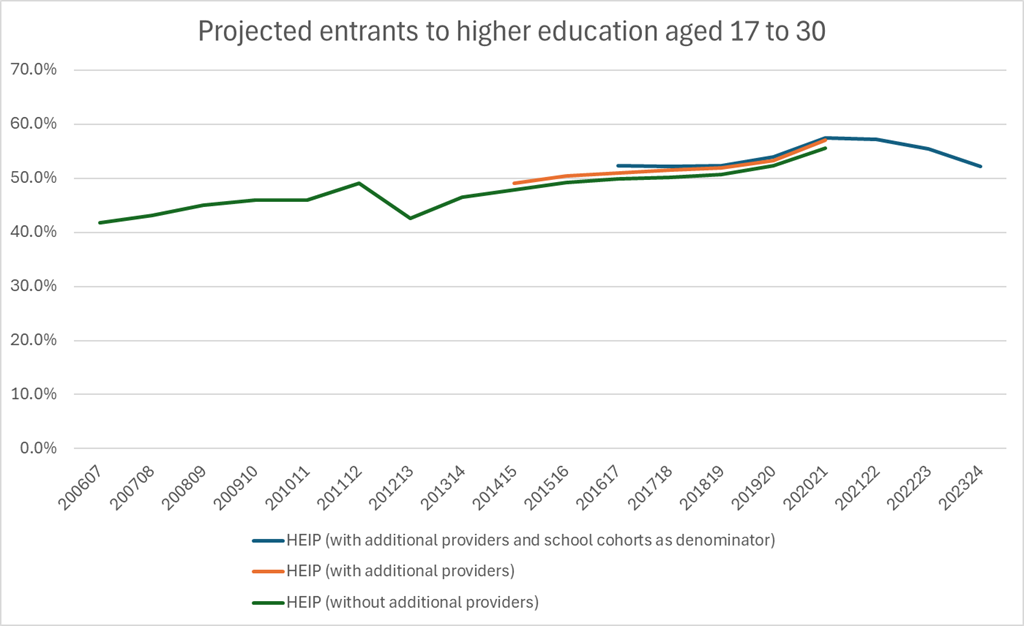
  • We can use the underlying data included in this release to understand how the HEIP measure might have looked had it continued to be published. In the 2020/21 to 2022/23 iterations of this series, this analysis was included in the main publication page.
  • Using the age specific data that we have included in the ‘Age’ section of this publication, it is possible to construct a ‘projected’ measure using the initial participation rates recorded for each of the 15-year-old cohorts in 2023/24. 
  • Whilst providing a more up-to-date estimate of participation levels by age 30, this suffers the same limitations as the previous HEIP measure, as it can only project future participation accurately if age-specific participation remains in a steady state year after year. As we see the number of 18-year-old entrants generally increasing each year, this impacts on the likelihood of participation in later years, and therefore impacts on the accuracy of this as a projection of future participation.

Comparing the projection from cohort data with the previous ‘projected’ measure

  • The data shows a decrease of 2.2 percentage points in the initial entry percentage derived from cohort data in 2023/24, down to 52.2% compared with 54.4% in 2022/23. 
  • The atypical sharp increase in participation between 2019/20 and 2020/21 is largely explained by the increased initial entry percentage that temporarily impacted all ages during the COVID-19 pandemic. This highlights the limitation with the suitability of this measure as a projection of future participation. The three year-on-year decreases in a row from 2021/22 to 2023/24 likely been caused by the initial entry percentages for ages 19 and over returning to pre-pandemic levels.
  • The initial entry percentages estimated from the cohort data tend to be larger than those estimated using the previous methodology. Such differences can be explained by:
    • using 15-year-old cohorts as the denominator rather than ONS population estimates (which would be impacted by incoming migration)
    • relaxing the requirement to participate in HE for a minimum 6-months
Projected entrants to higher education between 2006/07 and 2023/24, comparing three versions of the previous HEIP methodology

Other data sources

There are various other publications that provide estimated participation rates and show how these contribute to the skill levels of the working population in England.

UCAS Entry Rates

UCAS entry rates for 18-year-olds will be different to the equivalent 18-year-old participation rates reported in this publication, largely due to the following:

  • UCAS entry rates cover acceptances to an application cycle, so for the 2024 cycle this will include acceptances to the 2024/25 academic year as well as students who choose to defer and are accepted to the 2025/26 academic year. 
  • UCAS entry rates cover full-time undergraduate acceptances who applied through the UCAS system, whereas the CHEP rate covers all levels of study for both full-time and part-time students.
  • UCAS entry rates are calculated using ONS population estimates whereas the CHEP rates are calculated using the number of 15-year-olds in a given academic year, based on the School Census.
  • UCAS entry rates include pupils from independent schools, whereas the CHEP rates only includes pupils from state schools and all special schools.

The UCAS End of Cycle 2025 Report (opens in new tab) shows that the entry rate to full-time higher education for English 18-year-olds at UK providers decreased from 37.8% in the 2022 application cycle to 36.5% in the 2023 application cycle, a decrease of 1.3 percentage points. The comparable CHEP rates refer to 18-year-olds in 2022/23 and 2023/24, who belonged to the 15-year-old cohorts of 2019/20 and 2020/21. The percentage of those cohorts that had participated in higher education by age 18 were 35.7% for the 2019/20 cohort, and 34.2% for the 2020/21 cohort, a 1.5 percentage point decrease. These are the two most recent cohorts for which we have CHEP rates for 18-year-olds.

UCAS also reports that the entry rate to full-time higher education for English 18-year-olds decreased from 36.5% in the 2023 application cycle, to 37.2% in 2024 and again to 37.1% in 2025.

The 18-year-old entrants in 2024 belong to the 15-year-old cohort of 2021/22, hence their participation rate by 18 will be published as part of the next release of CHEP statistics. Based on the UCAS 2024 entry rates, we could expect to see a decrease in the CHEP-18 rate for the 2021/22 cohort compared to the 2020/21 cohort.

Census 2021

The highest level of qualification obtained for individuals across England and Wales is collected as part of the Census. In March 2021, the percentage of people aged at least 16 in England that indicated their highest level of qualification was Level 4 or above was 33.9%. Education, England and Wales - Office for National Statistics (ons.gov.uk) (opens in new tab)

Percentage of the population qualified to higher education level

The Office for National Statistics (ONS) publishes statistics from the Annual Population Survey (APS) on the percentage of the population qualified to Regulated Qualifications Framework (RQF) level 4 or above, which is equivalent to higher education level.

The percentage of the population of England aged 25 to 29 qualified at RQF level 4 or above in the calendar year 2023 was estimated to be 57.5%. This is larger than estimates available using the corresponding CHEP rates. ONS estimates from the APS are not limited to pupils from state schools and special schools.

Alternative disaggregations of the APS are available at Nomis - Official Census and Labour Market Statistics (opens in new tab)

Help and support

Contact us

If you have a specific enquiry about Participation measures in higher education statistics and data:

HE Participation and Provider Statistics Team

Email: he.statistics@education.gov.uk
Contact name: Louis Erritt

Press office

If you have a media enquiry:

Telephone: 020 7783 8300

Public enquiries

If you have a general enquiry about the Department for Education (DfE) or education:

Telephone: 037 0000 2288

Opening times:
Monday to Friday from 9.30am to 5pm (excluding bank holidays)